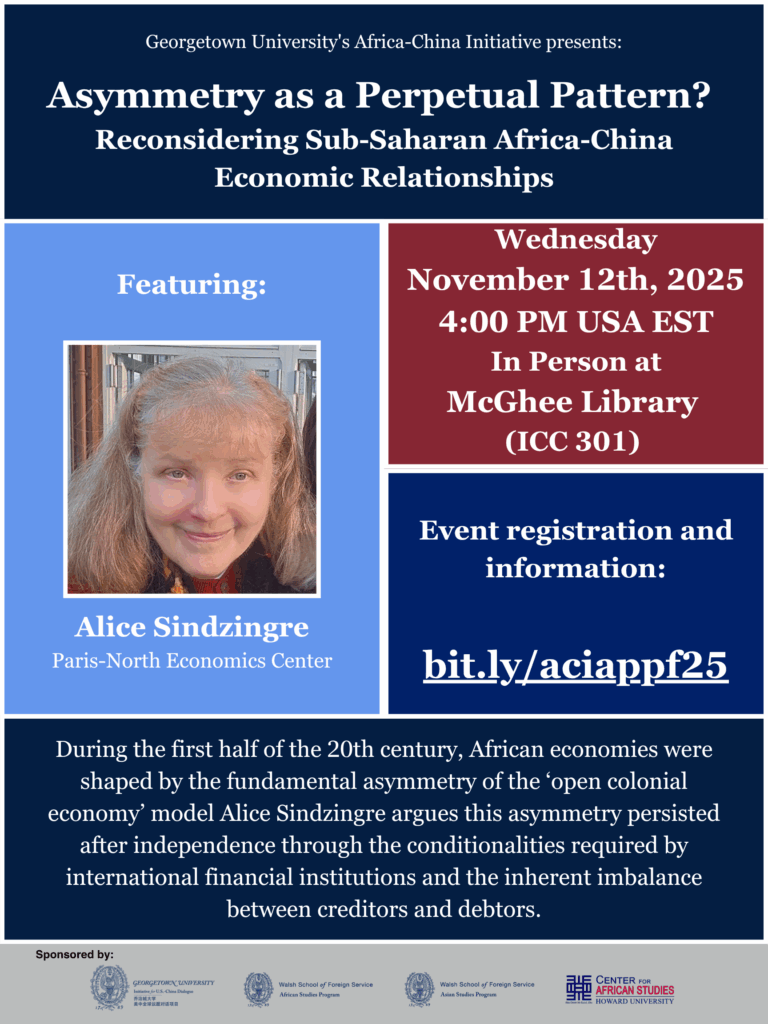
Asymmetry as a Perpetual Pattern? Reconsidering Sub-Saharan Africa-China Economic Relationships
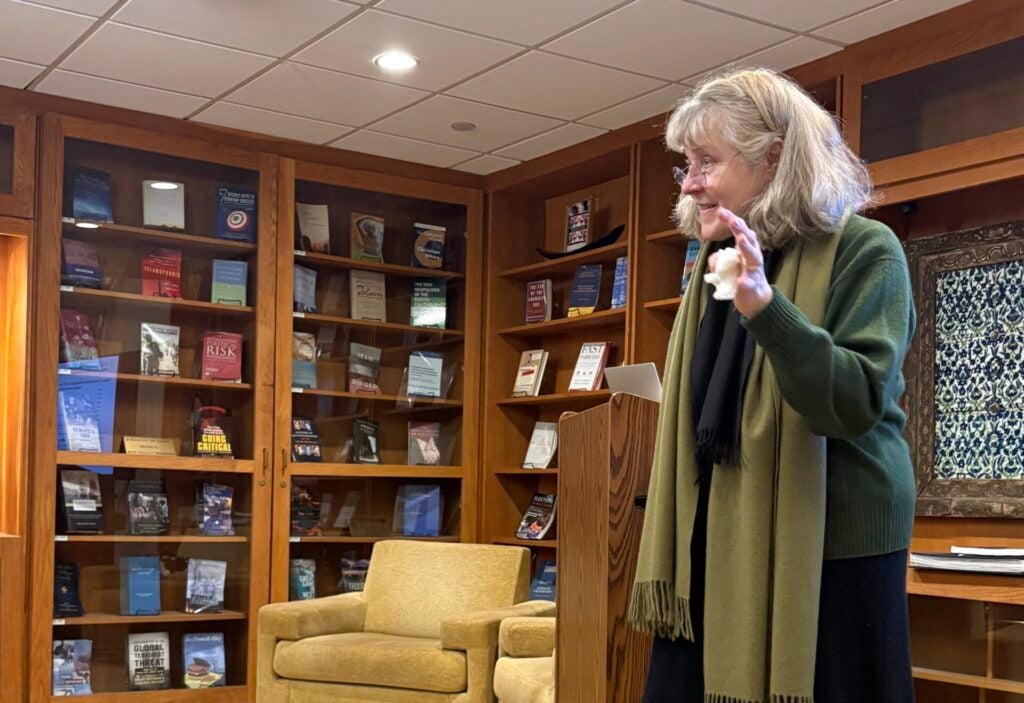
This event took place on November 12th, 2025 and was hosted in person at Georgetown University’s McGhee Library.
The economic relationships between Sub-Saharan Africa and China have intensified spectacularly since the end of the 20th century, with China becoming the region’s largest trade partner. While these relationships display unique characteristics, they also share commonalities with Sub-Saharan Africa’s economic ties to previous partners, particularly their asymmetry. During the first half of the 20th century, African economies were shaped by the fundamental asymmetry of the ‘open colonial economy’ model, characterized by the export of primary commodities and the import of manufactured goods from colonial powers. This asymmetry persisted after independence through the conditionalities required by international financial institutions and the inherent imbalance between creditors and debtors. China, therefore, does not appear to disrupt the asymmetric pattern of Sub-Saharan Africa’s external economic relationships. It is argued that this perpetuation stems from the historically entrenched nature of this asymmetry and the poverty traps it has created within African economies.
This event was co-sponsored by Georgetown University’s Africa-China Initiative and Initiative for U.S.-China Dialogue on Global Issues.
Featured
Alice Sindzingre is a Research Associate at the CEPN (Paris-North Economics Centre), University Sorbonne-Paris-North (France) and at the Centre for African and Development Studies (CEsA), Lisbon School of Economics and Management (ISEG), University of Lisbon (Portugal). Dr Sindzingre spent the majority of her career with the French public agency for research, the National Center for Scientific Research (CNRS, Paris) as a Senior Research Fellow. She has also been for two decades Visiting Lecturer at the School of Oriental and African Studies (SOAS University of London), in the department of economics, where she was teaching the course on the Economic Development of Africa. She has been a member of the Core Team of the World Bank World Development Report 2000-1 on poverty. She has conducted research on development economics and political economy (including extensive fieldwork in West Africa) and has published more than a hundred articles in academic journals and edited books on a large range of topics, including international trade, foreign aid, China-Africa relationships, poverty traps, the theory of institutions, and the epistemology of economics.